
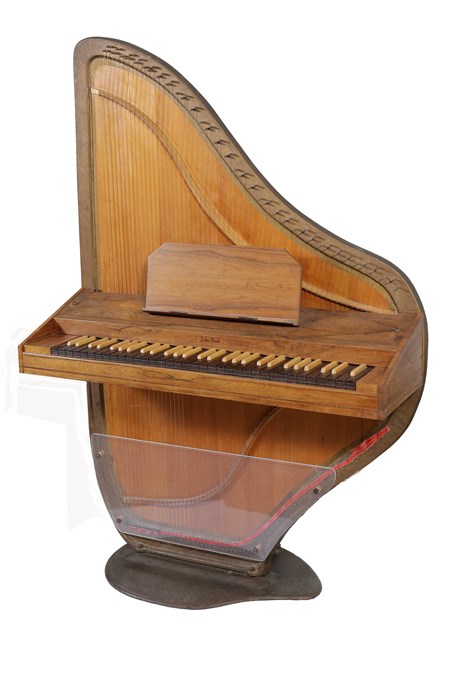
Typ / type : klawesyn (pośrednia forma między klawesynem a szpinetem) / harpsichord (intermediary form between harpsichord and spinet)
Właściciel/ Owner : Marek Toporowski
stan/state : bardzo dobry / very good
W Fortepianarium od 2025 roku.

Anglosascy budowniczowie w dużym stopniu nawiązywali do innych tradycji niż niemieccy. Warto tu wspomnieć, że to właśnie w Anglii takie firmy jak Kirckmann, Shudi& Broadwood najdłużej budowały klawesyny, w XIX wieku w Anglii, a Ignaz Moscheles w XIX wieku zorganizował cykl koncertów poświęconych muzyce dawnej wykonywanej na posiadanym przez siebie instrumencie. W II połowie XIX wieku takie koncerty wykonywał m.in. Edward Pauer, potem pojawił się Dolmetsch … .

XX-wieczne instrumenty angielskie są zazwyczaj przepięknie wykonane pod względem meblarskim, charakterystyczne są wyrafinowane intarsje. John Paul świadomie nawiązywał do tych tradycji, chętnie budował też instrumenty o niecodziennych formach. Inny niecodzienny instrument znajduje się w kolekcji Chrisa Maene w Brukseli:
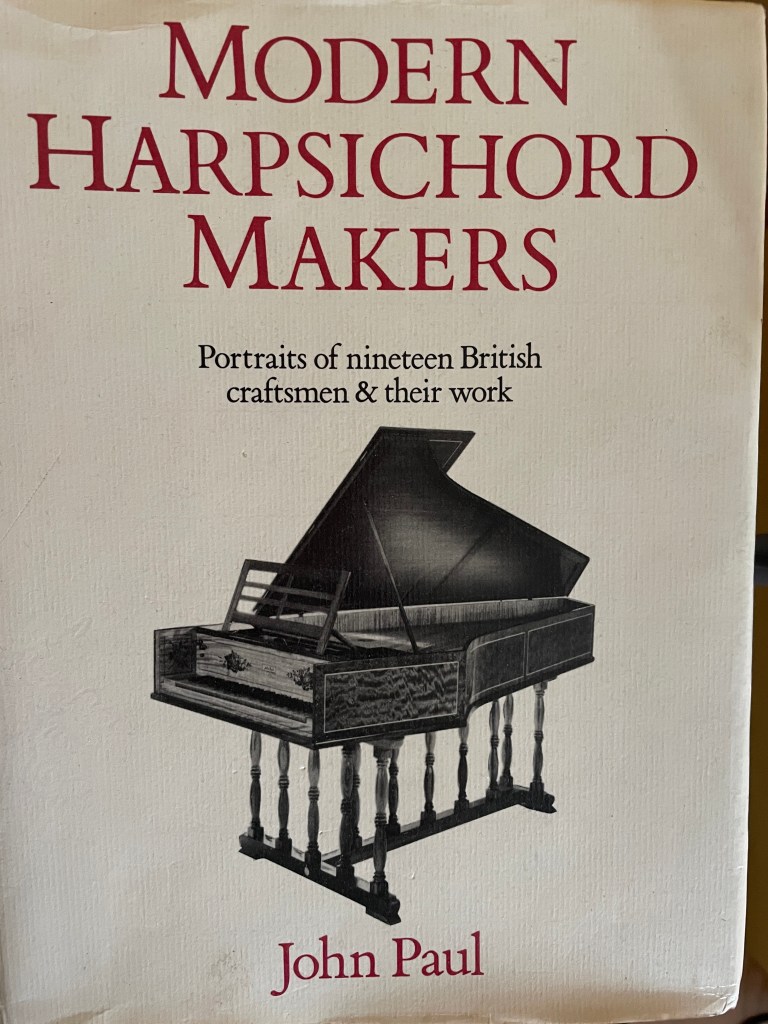
Napisał również ważną książkę książkę o współczesnych mu angielskich budowniczych.
Cembalo traverso to instrument pośredni między tym co dzisiaj określamy mianem klawesynu, a tym co nazywamy szpinetem. Rodzaj dużego trójkątnego szpinetu z rejestrem 8’ i 4’. Trochę podobne, ale owalne w kształcie instrumenty budował pod nazwą spinettone Bartolomeo Cristofori.

Zaletą cembalo traverso jest to, że grający ma przed sobą szerokie pole dźwięku. Dla grającego klawesynisty jest ito ciekawe doznanie dźwiękowe.
Ciekawe też, że przy stosunkowo ograniczonej dyspozycji : 8’, 4’, lutnia; dzieki temu, że lutnia jest pełnoprawnym „aktorem”, mamy dużo różnorakich możliwości barwnych.John Paul był autorem artykułu: „Harpsichord Tone Colour”. Problematyka koloru dźwięku była dla niego niewątpliwie ważnym aspektem budownictwa.
Anglo-Saxon builders largely followed different traditions to those of the Germans. It is worth mentioning here that it was in England that companies such as Kirckmann, Shudi& Broadwood built harpsichords unttil 19th century and Ignaz Moscheles organised a series of concerts devoted to early music performed on an instrument he owned. In the second half of the 19th century, such concerts were performed by, among others, Edward Pauer, then came Dolmetsch … .
Twentieth-century English instruments are usually beautifully crafted in terms of furniture; elaborate marquetry is characteristic. John Paul consciously referred to these traditions and was also keen to build instruments with unusual forms. Another unusual instrument is the clavicytherium in the collection of Chris Maene in Brussels:
He also wrote an important book about his English builders’ contemporaries.
The cembalo traverso is an intermediate instrument between what we today call a harpsichord and what we call a spinet. A kind of large triangular spinet with an 8′ and 4′ register. A somewhat similar but oval-shaped instrument was built under the name spinettone by Bartolomeo Cristofori.
The advantage of the cembalo traverso is that the player has a wide sound field in front of him. It is also interesting that with a relatively limited disposition : 8′, 4′, lute; thanks to the lute being an autonomous register, we have a lot of different colour possibilities. It is worth mentioning, that John Paul was the author of the article: ‘Harpsichord Tone Colour’. The issue of tone colour was undoubtedly an important aspect of construction for him.
 Fortepianarium